Michelin has graded Bordeaux. Latour is not on the list.

On the eighth of September, Michelin published its first classification of Bordeaux estates. It handed out grapes the way it hands out stars to restaurants, and it did exactly what any new ranking does in a region that built its reputation on an old one: it stirred the water. Famous names ended up in the second row, estates with no historical classification at all reached the top — and Château Latour, one of the five First Growths of 1855, is not on the list at all.
This is part three of Building bordeaux.guru. In the first part I built the maps and the climate database, in the second the MCP server, so that an AI could draw on that data too. This one is different: I am not building anything new, I just finally have enough of my own data to answer someone else's classification with numbers instead of impressions. Of the 83 rated estates we have 44 tasted and written up first-hand. So I compared.
What Michelin actually published
The selection was presented on 8 September 2026 at the Cité du Vin in Bordeaux, following the Burgundy premiere in July. It rates the estate as a whole, not an individual wine or vintage — which puts it closer to a classification than to a critic's score. There are five criteria: viticulture and agronomy, technical mastery in the cellar, identity and sense of place, balance, and consistency across vintages.
The split looks like this: nine estates with three grapes, sixteen with two, thirty-seven with one, and a further twenty-one merely "Selected" with no grape at all.
The three-grape estates are Lafite Rothschild, Léoville Las Cases and Montrose on the left bank; Petrus, La Conseillante and Lafleur in Pomerol; Cheval Blanc and Figeac in Saint-Émilion; and d'Yquem in Sauternes.
There is a small trap in the very first number, which I hit while checking the facts. Michelin itself gives two of them: the corporate press release says 83 estates, the English guide article says 84. Added up by category — 9 + 16 + 37 + 21 — you get 83. So I am going with eighty-three, and I mention it mainly because when two channels of the same publisher disagree on the sum of their own list, it is worth knowing which number you are working with.
Latour is not the only one missing
The absence of Château Latour is the story of this release. A Premier Cru from 1855, the archetype of Pauillac Cabernet, an estate that has stood outside the en primeur system since the 2012 vintage so it can release its wines when they are ready — and it is not on the list, not even among the "Selected". With no explanation given.
But read the list carefully and Latour is not alone. Ducru-Beaucaillou and Léoville Poyferré, both Saint-Julien second growths, are missing too, as is Château Pavie in Saint-Émilion. Four names that would sit high in any other ranking of Bordeaux.
It shows best on a map. I drew this one from my own château coordinates and the appellation boundaries in my database — the Michelin grapes are only the colour of the dot:

Those four dashed rings are not out on some periphery. Latour, Ducru-Beaucaillou and Léoville Poyferré sit right in the band between Pauillac and Saint-Julien where rated estates are densest. Their neighbours all have grapes.
The account winetipss summed it up with the most sensible line written about the whole affair: "Absence isn't a score." It is not a mark. This is a first selection and Michelin never promised it would be complete. Yet when your opening statement says you measure consistency across vintages and sense of place, the absence of Latour is a claim in itself — and it is fair to ask what it means.
Two hierarchies, a hundred and seventy years apart
More interesting than the missing names is how far the new lens has drifted from the old one. Of the five First Growths of 1855, only Lafite was given three grapes. Margaux, Mouton Rothschild and Haut-Brion each got two. Latour got none.

And the other way round: Montrose and Léoville Las Cases, both second growths, climbed all the way to the top. Three of the nine highest ratings went to Pomerol — an appellation that has never had a classification at all. Petrus, Lafleur and La Conseillante were never placed in any classified tier, because there was never a system there to place them in.


The 1855 classification measured prices and merchants' reputations. Michelin 2026 claims to measure the vineyard and what ends up in the glass. Same soil, same rivers, a different lens — and you can see how far those two things have drifted apart in a hundred and seventy years.
Do I actually agree with it?
Here begins the part nobody who is merely reprinting the list can write. We have our own notes on 44 of these estates — forty-two from the barrel, two from the bottle — so I can ask the question directly: does it come out the same way for us?
I got it wrong on the first attempt, and it is worth saying how, because the mistake is instructive. I simply took each estate's highest score across vintages — and got a beautiful correlation. Except that we taste as a team and that team is not the same from one vintage to the next: our average for 2025 runs seven points higher than for 2024 (96.3 against 89.3). Estates we only have from 2025 were lifted automatically. Meanwhile all nine of the "Selected" estates we have only from 2024. That "beautiful correlation" was largely an artefact of who stood at which barrel.
So, again, honestly: the 2024 vintage only, only our scores from it, 34 estates.

The answer is: broadly yes, in detail not at all.
The downward trend is there — "Selected" estates average 89.3 with us, one-grape estates 90.9. But between three grapes and two there is no difference in our numbers at all; we actually have two grapes marginally higher (93.5) than three (92.4). The rank correlation between grape count and our points comes out at 0.51 — but only when estates in the selection without a grape are counted in as zero. Across one, two and three grapes alone it drops to 0.30. In other words: we mostly agree on which estates belong at the very bottom. On the order of the rated ones we barely agree at all.
We also checked whether that figure depends on how we represent an estate. We take its highest-scoring wine of the vintage; had we used only the red grand vin, the result would be 0.49 instead of 0.51. A difference of two hundredths means the conclusion does not rest on that choice.
The individual cases say more than the coefficient:
- Calon Ségur and Rauzan-Ségla have one grape each. Both scored 95 with us — exactly what Figeac scored, and Figeac got three.
- Pédesclaux is merely "Selected". With us it scored 93.5, higher than most estates that were given a grape.
- Branaire-Ducru does have a grape, but at 83.5 points it sits at the very bottom of our whole list.
- And the most telling pair of all: Lafite, with three grapes, scored 89.5 with us in 2024, while Calon Ségur, with a single grape, scored 95. A three-grape estate came out below a one-grape one — same taster, same vintage.
- Lafite, the only First Growth with three grapes, scored just 89.5 with us in 2024. For 2025 it scored 99. One and the same vineyard, two consecutive vintages.
That last item is in fact the best argument for what Michelin is doing. Scoring a wine means scoring a vintage. Classifying an estate means claiming something about a place that outlives vintages. Those are two different jobs, and our numbers show how far apart they can drift — Lafite 2024 and Lafite 2025 sit nearly ten points from each other.
And then there is Léoville Poyferré, absent from the Michelin list entirely. We have it from 2024 and gave it 90.5 points — more than we gave, in that same vintage, to five estates that did receive a grape. One of them is Lafite.
Three theories going around — and what our numbers say about them
A layer of interpretation grows around every new classification within a week. Three of them I have heard often enough to be worth testing — and since I have my own data, I do not have to leave them at guesswork.
"Michelin punishes new oak"
The most widespread theory says inspectors are looking for elegance and reject wines marked by new oak — and that this is exactly why estates associated with a richer, more extracted style are missing. It sounds plausible. Except that for every château I record the share of new oak from its technical sheet, so I do not have to guess.
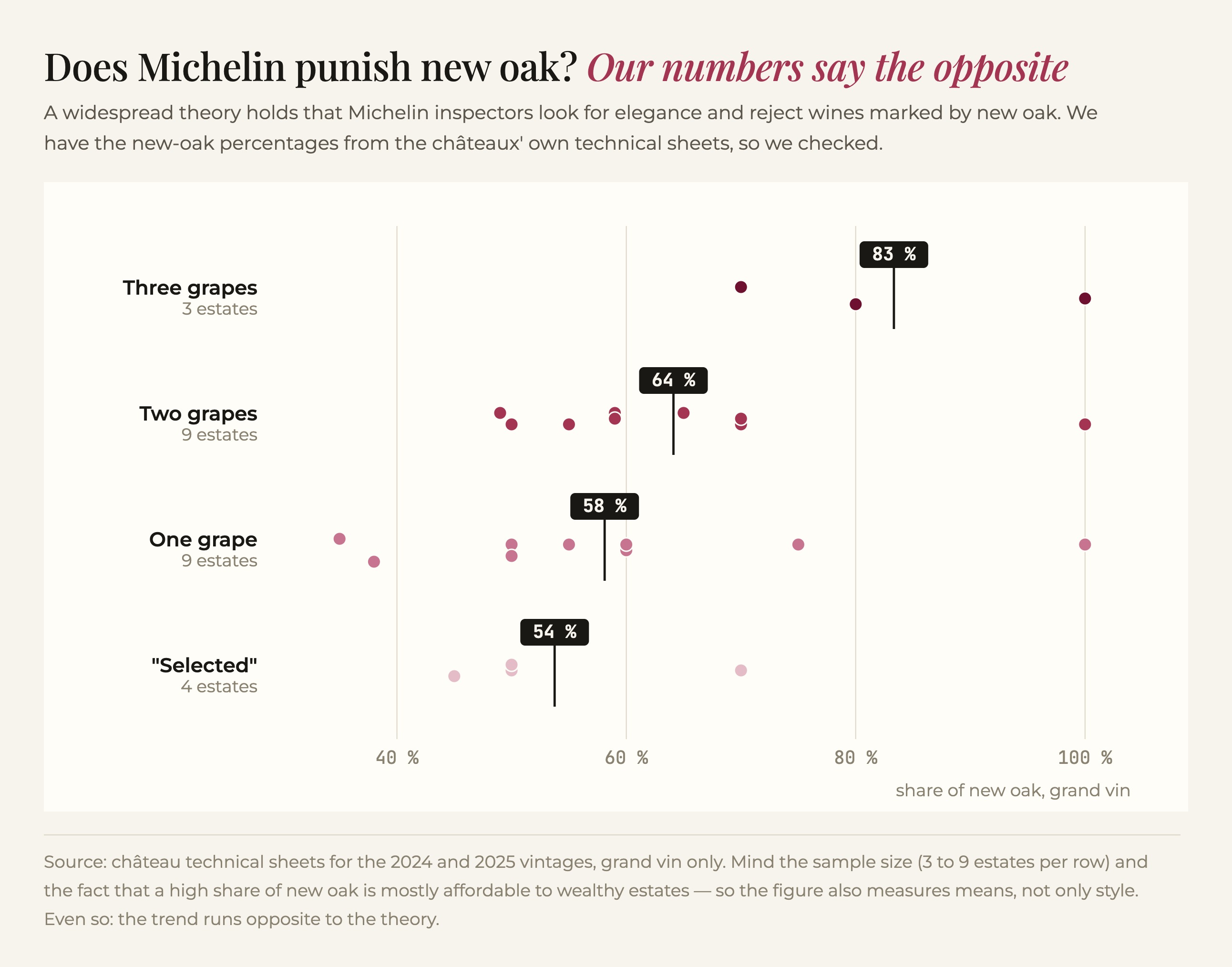
The trend runs in exactly the opposite direction to the theory. Three-grape estates average 83 % new oak, two-grape 64 %, one-grape 58 % and "Selected" 54 %. Cheval Blanc, one of the nine highest-rated, ages in one hundred per cent new oak. So does Calon Ségur — and it has a single grape.
To be fair about it: the sample is small (three to nine estates per row) and a high share of new oak is mostly affordable to wealthy estates, so the figure measures means as well as style. But as a refutation of the simple equation "lots of oak equals no grape", it is enough. Michelin is evidently not grading the recipe, but the result.
"The value now sits in the one- and two-grape estates"
The second theory says prices of rated but less famous estates will shoot up. I cannot and will not predict prices, but I can show where things stand today, because I also track the campaign's offer prices.
The median en primeur price for the 2025 vintage comes out at €144 for three-grape estates, €137 for two-grape and €67 for one-grape. The most interesting ratio of our score to price belongs to Brane-Cantenac (€40 at our score of 97) and Larcis Ducasse (€41 at 98) — both with a single grape. At the other end sits Le Pin: one grape and a price of €1,834, which on its own shows how little the grapes say about price.
This is an editorial observation, not investment advice — and it describes today, not the future.
"There is politics behind the absences"
The third theory explains the missing names by what happens backstage: that certain estates supposedly refused to cooperate or would not let inspectors into the cellar. It may well be so. But there is no source for any of those versions — they are conjectures that turn into "common knowledge" by repetition.
I stick to what can be documented: since the 2012 vintage Latour has stood outside the en primeur system by choice, so its wine year meets the trade differently than the rest of the region does. What Michelin made of that, it did not say. The rest would be my own guess, and that does not belong in an article.
Why I will not put these numbers in my database
The obvious question was whether to display the Michelin grapes on each château page. I decided against it, and the reason matters, because it is bound up with why I run bordeaux.guru at all.
The site does carry the 1855 classification, the Saint-Émilion classification and Cru Bourgeois. Those are historical facts about an estate, like vineyard area or appellation. Michelin grapes, by contrast, are somebody else's fresh judgement — and I do not copy other people's judgements. The moment I start, I become an aggregator gluing foreign scores into a table, and the internet is full of those. The only thing worth offering is a score I gave myself, to a wine I tasted myself.
Quoting the numbers in an article is a different matter — that is reporting on what happened in the region. But they do not belong on the château page.
What I take away from it
I think the Michelin selection is a useful thing. It is transparent about its criteria, it rates estates rather than individual bottles, and it is not afraid to put Pomerol next to the First Growths, which nobody dared to do for a long time. It is also a first attempt and behaves like one: it is missing names whose absence nobody has explained, and Michelin contradicts itself on the size of its own list.
Our own numbers agree with it about as much as two tasters at the same table agree with each other — on which wine is weak we almost always concur; on which of five excellent wines is best, almost never. That is the normal state of affairs, and it is fair to say so out loud even when our own data fails to confirm somebody else's verdict.
If you want to see how I rate these estates, all the wines and scores are on bordeaux.guru — the scores are free to read, the full notes are for members. The appellation maps the one in this article was drawn from live at bordeaux.guru/maps.
Sources for the Michelin figures: the MICHELIN Guide and the Michelin press release (8 September 2026), with Vino Joy News and Falstaff as supporting reporting. The scores, the map and both charts come from bordeaux.guru's own data. Château photographs: Lafite Rothschild — Giogo, CC BY-SA 4.0; Léoville Las Cases — BillBl, CC BY 2.0, both Wikimedia Commons.