There is no European customer: how people pay and get deliveries in 35 countries
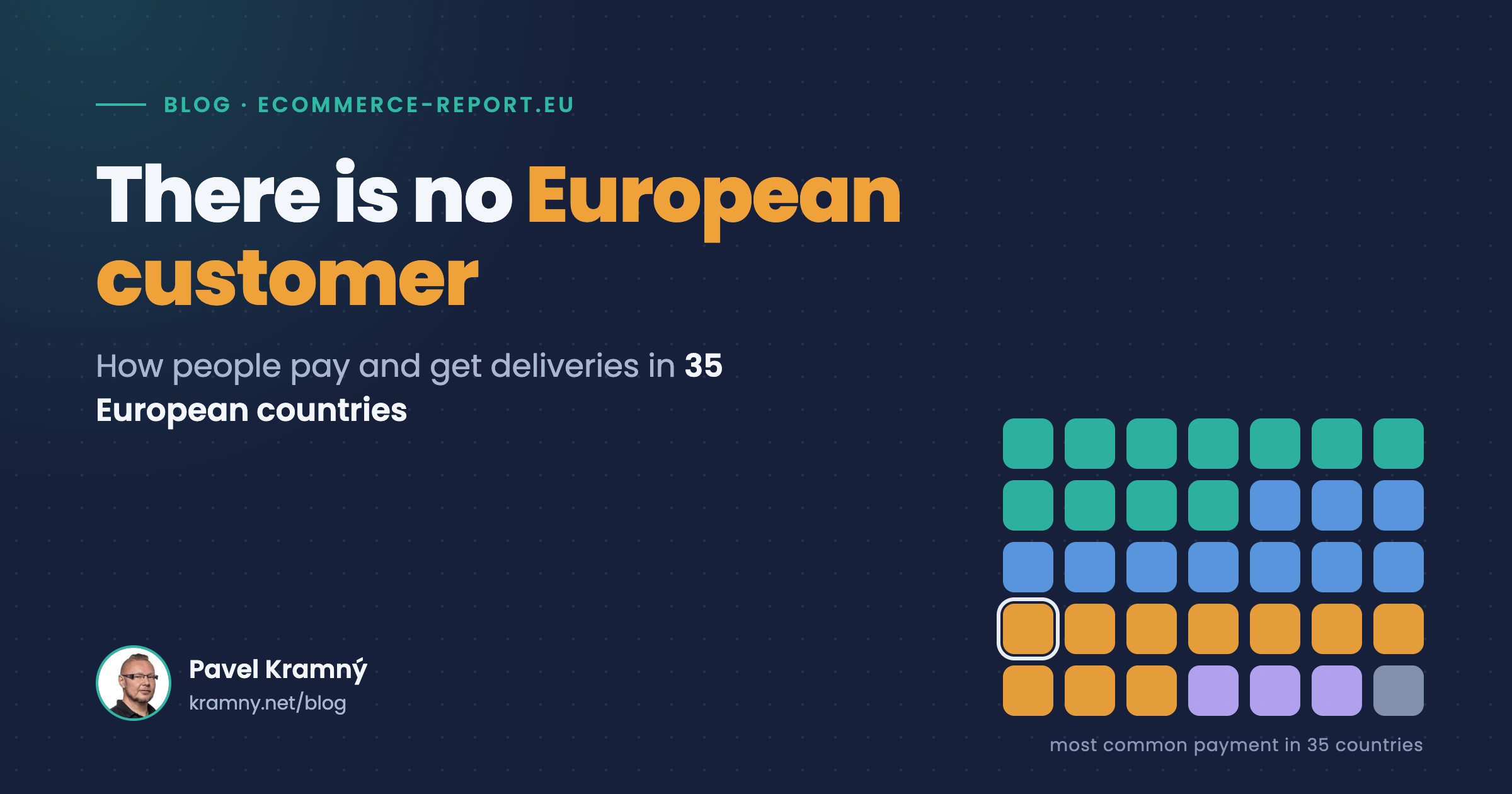
Europe is talked about as one market: shared rules, free movement of goods, one “European customer”. You will not find that customer in the data. At ecommerce-report.eu we collect figures on 35 European markets: 24 EU countries, the United Kingdom, Switzerland, Norway, Iceland, Ukraine, Moldova and five Balkan countries. For each one we track not only the size of the market but also how people buy there: the most common payment method, the most common delivery option, the main search engine and the leading marketplace.
Put those four columns side by side and one thing stands out: an online store that wants to sell abroad has to rebuild itself a little for every country. Here is exactly what changes.
Five ways to pay
Across the 35 countries the number-one payment method splits into five groups, and none of them has a majority:
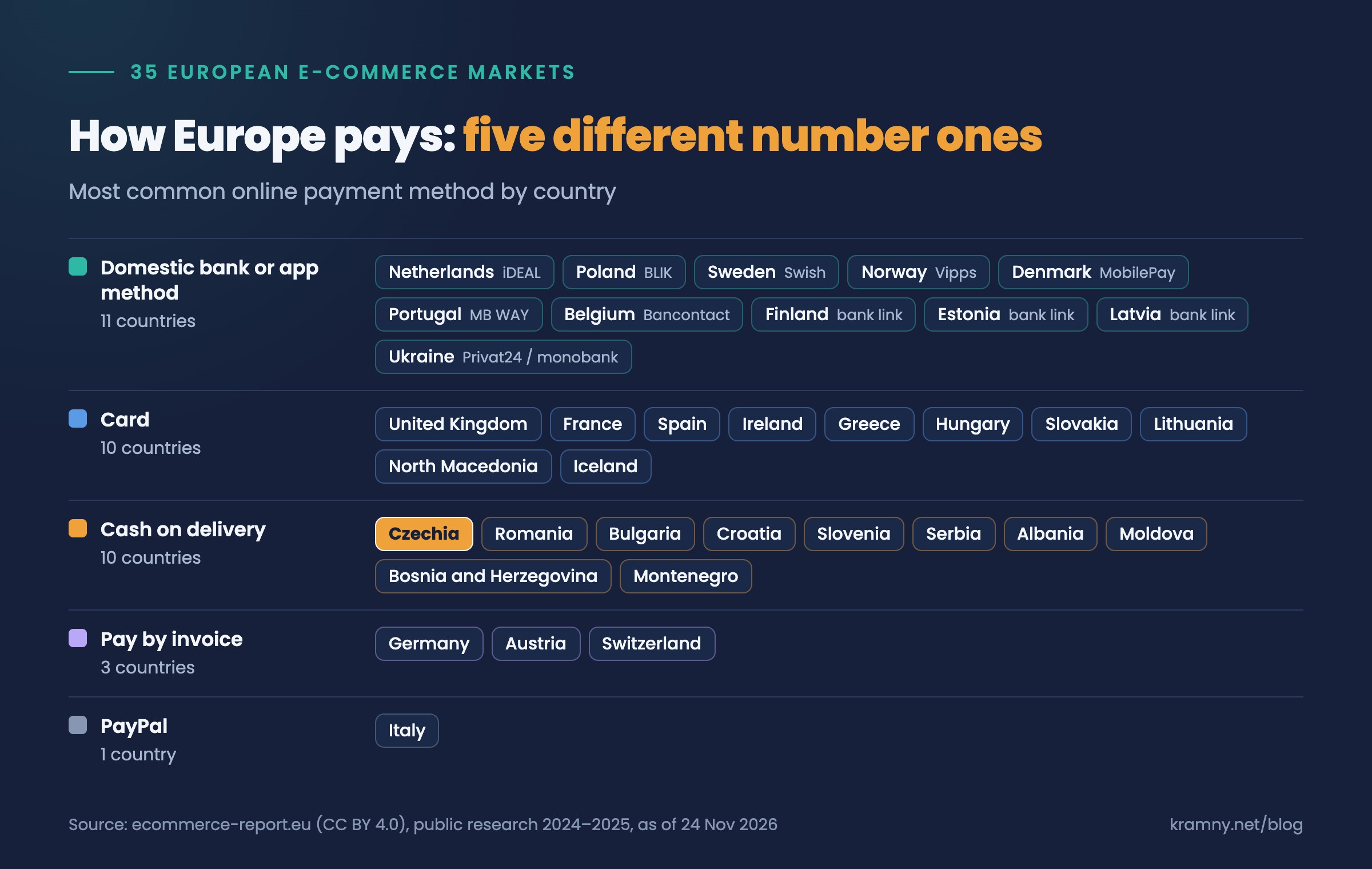
- A domestic method (11 countries). The Netherlands pays with iDEAL (over 70% of online transactions), Poland with BLIK, Sweden with Swish, Norway with Vipps (used by about three quarters of the population), Denmark with MobilePay (about 90% of Danes), Portugal with MB WAY, Belgium with Bancontact. In Finland, Estonia and Latvia online bank-link payments lead, and in Ukraine the banking apps Privat24 and monobank. Outside their home country hardly anyone knows these methods, and nobody expects them elsewhere.
- Card (10 countries). The UK, France (Carte Bancaire), Spain, Ireland, Greece, Hungary, Slovakia, Lithuania, North Macedonia and Iceland.
- Cash on delivery (10 countries). Czechia, Romania, Bulgaria, Croatia, Slovenia, Serbia, Albania, Moldova, Bosnia and Herzegovina and Montenegro. In Romania roughly half of all orders are paid on delivery.
- Pay by invoice (3 countries). Germany, Austria and Switzerland. “Kauf auf Rechnung” is a sign of trust there: the customer pays after seeing the goods.
- PayPal (1 country). Italy.
That leads to simple arithmetic. A store that offers only card and PayPal matches the most common payment method in 11 of 35 countries. In the other 24, the customer at checkout looks for something that is not there.
Delivery: the post in the West, lockers in the East
With delivery the split even shows on a map. In Western and Northern Europe the national post leads: Royal Mail, Colissimo, DHL in Germany, Correos, PostNL, bpost, Swiss Post, PostNord, Posten/Bring or Posti. The exception is Italy, where the private BRT comes first.
In Central and Eastern Europe, pickup points and parcel lockers run by private companies win:
- Poland: about 83% of people choose delivery to an InPost Paczkomat locker.
- Czechia and Slovakia: Packeta (Zásilkovna) comes first. In Czechia about 40% of orders go to pickup points and lockers.
- Hungary: Foxpost. The law also requires shops to offer the state post, MPL.
- Romania Sameday easybox, Estonia Omniva lockers, Ukraine Nova Poshta with Europe's largest single-country locker network (480 million parcels in 2024).
So the parcel locker is not a Czech quirk. In France or the UK, though, the post comes first, and in Belgium the rules say a store must offer at least two delivery options.
Google everywhere, Amazon only in places
The one thing that is the same in all 35 countries: the main search engine is Google.
Not so with marketplaces. Amazon is number one in ten countries, almost all in the West and North: the UK, France, Germany, Spain, Italy, Austria, Sweden, Denmark, Ireland and Iceland. In the other 25 a local player leads. Allegro holds over half of the Polish market, Bol.com leads in the Netherlands and Belgium, eMAG in Romania, Hungary and Bulgaria, Alza in Czechia and Slovakia. Then there is Digitec Galaxus in Switzerland, Skroutz in Greece, Worten in Portugal and Rozetka in Ukraine. In Central and Eastern Europe, Amazon is number one only in Austria.
Where Czechia fits
With €7.7 billion in online turnover, Czechia is the 15th largest of the 35 markets. 83.7% of people buy online, more than in Germany (81.4%) or France (80.2%). Yet the most common payment is still cash on delivery, and in that Czechia is closer to Romania and the Balkans than to any of its neighbours: Germans and Austrians pay by invoice, Poles with BLIK and Slovaks by card.
For a Czech store going abroad, that means one practical thing. What works as a matter of course at home, cash on delivery and Packeta, is just one option across the border. Often not the one the customer looks for first.
What I take from this for a store going abroad
- Choose payments by country, not by gateway. The question is not “which payment gateway” but “does it support iDEAL, BLIK, invoice and MB WAY?”. For Germany and Austria, plan for pay by invoice.
- Set the default delivery per country. Paczkomat in Poland, DHL in Germany, Colissimo in France. What the customer sees as the first option decides.
- Use marketplaces as the way in. In the East, Allegro, eMAG or Bol.com pay off first, not Amazon.
- Read your own numbers country by country. A Europe-wide average hides that one country makes money while another loses it on shipping.
A profile of each of the 35 countries is at ecommerce-report.eu/markets, for example Poland or Czechia, each with its sources. The full data is free to download as an open dataset on GitHub under CC BY 4.0. To benchmark your own store against each market (revenue, margin, ad spend), there is e-shop.report.
Data: ecommerce-report.eu (CC BY 4.0), as of 24 November 2026. “Most common” means the method or carrier used by the most people in that country according to public research from 2024–2025. It is not the only option, and shares differ between sources. Turnover is the latest available figure for each market; national methodologies differ slightly. I deliberately leave growth figures out.