bordeaux.guru as an MCP server: en primeur data right inside your AI assistant
In August I launched the bordeaux.guru MCP server and wrote mostly about how it is built: one data gateway, two interfaces, and access control in the data rather than in the prompt. That second part was for people who build things. This one is for people who drink, collect and buy wine: what to ask your AI assistant and what it will answer.
This is part four of the Building bordeaux.guru series. Every example below is a real answer from the server on 10 November 2026, on the free tier — exactly what you get yourself, with no account and no key.
Connecting: one address, one minute
MCP (Model Context Protocol) is the standard an AI assistant uses to fetch data from other systems. The bordeaux.guru server is public, read-only, and there is nothing to install:
- Claude (desktop or web): Settings → Connectors → Add custom connector, paste
https://mcp.bordeaux.guru/mcpand confirm. The Bordeaux tools then appear in every new conversation. - Claude Code: one command in your terminal —
claude mcp add --transport http bordeaux-guru https://mcp.bordeaux.guru/mcp - Any other client that speaks remote MCP over streamable HTTP. The same address is all it needs.
Then you just ask in plain language. The assistant picks which of the fourteen tools to call, and every answer comes with its source and a link to the wine's page. Setup instructions and the full tool list are at bordeaux.guru/mcp-server. The server is also listed in the official MCP Registry as guru.bordeaux/en-primeur.
1. “What did Pontet-Canet cost en primeur?”
This is the newest part of the server. In August it knew scores and tasting notes; since September it also knows en primeur release prices — what the château asked for the wine while it was still in barrel. That is public information, so the server gives it to everyone, key or no key.
Ask about Pontet-Canet and it returns five vintages:
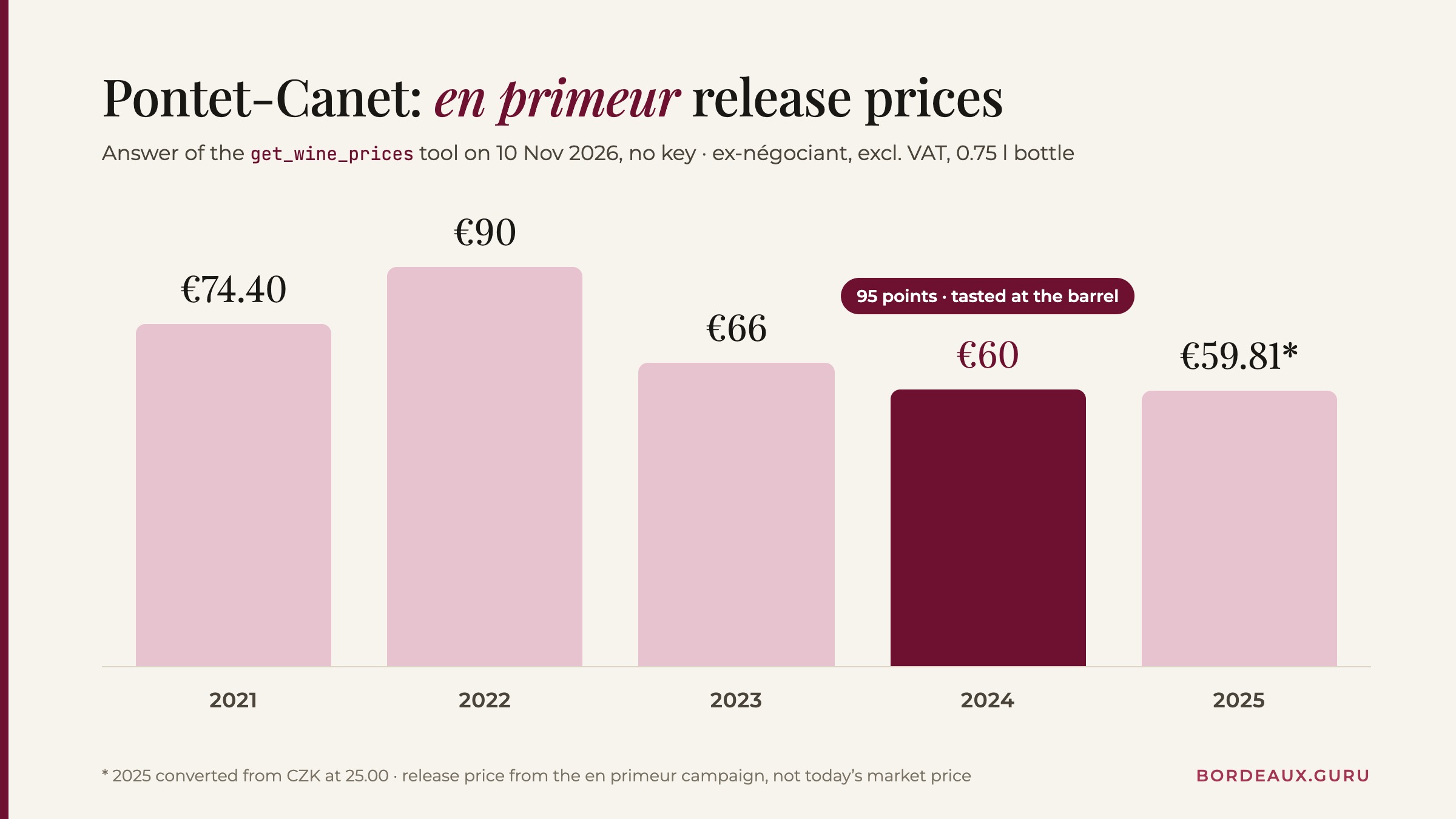
I tasted the 2024 at the barrel and gave it 95 points; my note calls it a big surprise. It was released at €60 — a third less than the 2022, which cost €90. Putting the score and the price side by side is exactly what I used to do by hand in a spreadsheet.
The server states two things about prices on its own, and they are worth knowing. This is the négociant price excluding VAT for a 0.75 l bottle, and it is the price from the en primeur campaign, not today's market price. The 2025 figure is converted from Czech crowns at 25 CZK/€, hence the odd number.
2. “Which 2024 Pauillacs are worth a look?”
A search by appellation and vintage returns wines with score, price and link. Five results without a key, up to fifty for members:
- Château Pontet-Canet — 95 points, €60
- Château Pédesclaux — 93–94
- Château Pichon Longueville Comtesse de Lalande — 93–94
- Château Mouton Rothschild — 93+, €252
- Fleur de Pédesclaux — 92–93
More interesting than the list itself is one small detail. For Pédesclaux the server adds that we also have a bottle tasting of the 2018 at 95 points, and hints to the assistant that it can fetch it. So the assistant, unprompted, connects the wine in barrel with how the same château tastes from the bottle years later.
3. “And how does it taste from the bottle?”
En primeur means tasting a wine that is still ageing in barrel a few months after harvest. A bottle tasting is a different discipline — the wine is finished, often years on. The server keeps the two apart and says so in every answer, so the assistant does not mix them up.
There are now 116 bottle tastings from ten events in the database, and they are not only the famous names. Ask about Château Marjosse and you get six entries across vintages 2012 to 2022, with date and event, score, drinking window and an indicative Czech retail price. The 2018 scored 92 points from magnum in May 2021 with a “drink now” window, and 85 from a regular bottle in November 2022. The full written note is for members; without a key you get the score, the drinking window and the opening line.
4. “What was 2024 like?”
The vintage profile is a summary built from tastings and climate data. For 2024 the server answers with the title “The Comeback Vintage” and numbers: the wettest spring in 47 years, 150 mm of rain in May and rain on 26 of the 47 days of the flowering window. Heat stayed below average — 1,527 degree-days, 32nd of 47 seasons. September added another 141 mm and the harvest was picked between weather fronts; the sorting table decided.
According to the profile, Pessac-Léognan, Saint-Estèphe, Saint-Émilion and Pauillac did best, with an ageing potential of 15–30 years for the top wines. The profile rests on 131 tasted wines. The server also adds a “buy” signal — with a note right next to it saying it is not investment advice, only a personal tasting impression.
5. “What was this summer like in Pauillac?”
Climate is free for Pauillac and the latest season; other appellations and earlier years are for members. According to the stored ERA5 data, the 2026 season from April to October looks like this: 2,200 degree-days above 10 °C, 61 days with a maximum of at least 30 °C, 18 of them above 35 °C, an absolute maximum of 41.8 °C, 322 mm of rain and 2,452 hours of sunshine. Not a single frost day.
Without data, an AI answers this kind of question with a generic line about “a warm vintage”. With data you get numbers you can work with, plus a link to the maps where you can replay the season day by day.
What is free and what is for members
- Without a key: scores, châteaux, appellations and vintages, en primeur release prices, bottle tastings (vintage, score, drinking window), the opening line of every note, Pauillac climate for the latest season and terroir samples. Five results per search, 20 calls a day (at most 5 per minute).
- With a Cellar key: full en primeur and bottle notes, every appellation and season, climate comparisons, a wine's price position against its vintage curve, 50 results per search and 500 calls a day.
Price position answers the question every en primeur buyer asks: is this wine expensive or cheap for its quality? The 2024 vintage curve is built from 74 wines with a known price. Without a key the server returns the release price and says that the position itself is a members' feature.
Personal keys come with the Cellar tier, which we are still preparing; the contact for anyone interested is on the MCP server page. And if you want to read a full note for free, the site has an assistant called Ask the Guru: every signed-in visitor gets one sample note a day from a curated set of eight wines.
Why I am doing this
En primeur notes are written every spring at the barrels in Bordeaux and exist nowhere else on the web. When someone asks an AI about them, the model either admits it does not know or — more often — confidently makes up a number. The MCP server turns that around: the data stays with us, under our rules, and the assistant comes to fetch it whenever somebody asks. Every answer carries its source and a link back to bordeaux.guru, so it can be checked.
I build the same idea in e-commerce: e-shop.chat uses MCP to connect an AI assistant to an e-shop's products, orders and delivery. For wine and for e-shops alike it is one thought — AI should answer from data that somebody actually measured, not from whatever it happened to find on the internet.
Try it: the address is https://mcp.bordeaux.guru/mcp and connecting takes a minute. And if you ask your assistant something it cannot find an answer to in the data, tell me — questions like that decide what goes into the database next.
All examples are real answers from the mcp.bordeaux.guru server on 10 November 2026, on the free tier, with no key. En primeur release prices are négociant prices excluding VAT, not today's market prices; the 2025 vintage is converted from Czech crowns at 25.00 CZK/€. Vintage profiles and signals are not investment advice. Climate data: Open-Meteo / Copernicus ERA5, stored and processed by bordeaux.guru.